New Tax Updates
Maryland - Paid Family Leave
DELAYED: Contributions have been delayed until January 1, 2027 with benefits to begin January 1, 2028. This was confirmed through an agency newsletter received 4/08/2025 that confirmed the final bill passed to delay the start of this tax.
Paid Family and Medical Leave
Minnesota – Paid Family Leave
Effective: January 1, 2026
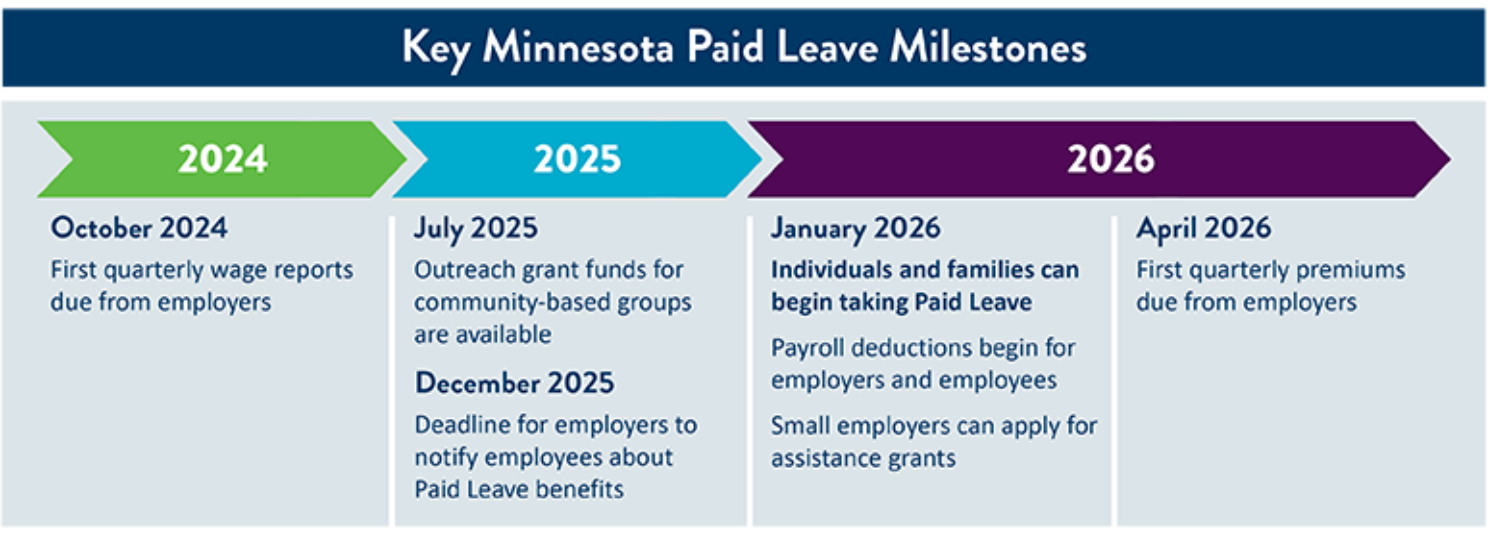
The premium rate will be 0.88 percent. The premium rate is a percentage of an employee's wages that will be collected by the state from employers. The premiums will be split between employees and their employers. Employers must pay at least 50 percent of the total premium and can deduct the remainder from employee pay. Employers may also choose to pay up to 100 percent of the premium for their employees. Small employers pay a reduced premium rate.
Premiums are due to the social security wage base limit.
Employee count: The employee count is the largest number of Minnesota employees reported by an employer on a single wage detail report during the four-quarter period that ended September 30 of the prior year. When the program launches in 2026, this will be the highest number of Minnesota employees reported in a single quarter between October 1, 2024 and September 30, 2025.
If this count is 30 or fewer employees, the employer may qualify for a reduced small employer premium rate. Independent contractors and self-employed individuals are not included in this count. Employers who qualify for the reduced small employee rate are responsible for half of the standard employer contribution.
Individuals are covered by Paid Leave if they work 50 percent or more of the year in Minnesota.
Tax codes will be added to client accounts with active MNSUI tax code. The default setting will be the split contribution as established by the agency plan. If an employer chooses to cover the full contribution, they will be required to work with their Account Manager to adjust the tax code on their account. Similarly, if an employer has an approved private plan, they will need to work with their account manager to update the tax codes on the account to the private plan tax codes.
Employers / Minnesota Paid Leave
Federal Updates
FUTA Credit Reduction
California
California will be assessed a general FUTA credit reduction of 1.2% on wages paid to employees. The reduction will cause employers to pay an effective federal unemployment tax rate of 1.8%, or up to $126 for each employee when applied to the federal unemployment-taxable wage base of $7,000.
ProLiant will apply this update to all applicable Forms 940 for the Form 940 annual filings.
Virgin Islands
Employers in the U.S. Virgin Islands will be assessed a general FUTA credit reduction of 4.5% on wages paid to employees, which will result in an effective federal tax rate of 5.1%, or up to $357 for each employee when applied to the $7,000 wage base
ProLiant will apply this update to all applicable Forms 940 for the Form 940 annual filings.
Paid Family Leave – Reporting Update
The IRS has issued guidance on the income and employment tax treatment of contributions and benefits paid under a state paid family and medical leave program, as well as the related reporting requirements. Rev. Rul. 2025-04 provides clarification on the tax treatment and reporting on both the contributions into the State PFML programs and the benefits paid out from the State PFML programs.
Under the revenue ruling, there are three possible types of contributions into a state program with respect to a given employee:
- Required employer contributions: Not taxable to employees. No reporting.
- Required employee contributions (generally withheld via payroll): Taxable income and wages reported on Form W-2, Wage and Tax Statement.
- Voluntary employer pick-up contributions (as permitted): Taxable income and wages reported on Form W-2.
Tax Deductions for contributions to State PFML Programs
- Employer: Contributions, whether mandatory or voluntary employer pick-up contributions, are deductible as business expenses (either as wages or as excise taxes).
- Employees: Contributions included in the employee’s taxable income (as discussed above) may be tax deductible on an employee’s own federal income tax return as state and local income taxes (up to limitations) if the employee itemizes deductions.
Reporting
The federal income tax treatment and reporting of benefits paid out of State PFML programs to employees differs based on whether amounts are attributable to employer contributions, including voluntary employer pick-up contribution, or employee contributions and whether the employee is receiving benefit payments for family leave or medical leave under the State PFML program.
In general, tax treatment is as follows:
- Family Leave Benefit Payments
Amounts attributable to required employer contributions, required employee contributions, and voluntary employer pick-up contributions:
Taxable income to the employee but not treated as wages and thus not subject to withholding and not reportable on Form W-2.
An employee who receives state-paid family leave payments must include those amounts in the employee’s gross income. The state will report such amounts to an employee on Form 1099.
- Medical Leave Benefit Payments
Amounts attributable to mandatory employer contributions:
An employee who receives state paid medical leave payments must include the amount attributable to the employer portion of contributions in the employee’s gross income. This latter amount also is subject to both the employer’s and employee’s shares of Social Security and Medicare taxes. The amount attributable to the employee’s portion of the contributions is excluded from the employee’s gross income, and this amount is not subject to Social Security or Medicare taxes.
Generally treated as taxable income and wages unless amounts can be excluded under sections 104 and 105 (relating to amounts treated as received through accident or health insurance).
For reporting, the taxable medical leave benefit is treated as third-party sick pay paid by a party that is “not an agent of the employer.” Under this rule, while federal income tax withholding is not required, an employee can request federal income tax withholding on these taxable amounts. Social Security and Medicare tax withholding may also be required, and the amounts are usually reported on Form W-2.
The IRS stated the 2025 calendar year is a transition year for both employers and state agencies, allowing time to configure reporting and other systems.
For medical leave benefit payments attributable to employer contributions made during 2025:
- The state or employer is not required to follow the withholding and reporting requirements applicable to third-party sick pay.
- The state or employer will not be subject to penalties for failure to correctly file information returns or employee payee statements.
- The state or employer is not required to withhold and pay associated taxes and is not liable for associated penalties.
Additionally, the employer is not required to treat voluntary employer pick-up contributions as wages for federal employment tax purposes.
IR-2025-16
Retirement Plan Limit Updates
FUTA Credit Reduction
California
California will be assessed a general FUTA credit reduction of 1.2% on wages paid to employees. The reduction will cause employers to pay an effective federal unemployment tax rate of 1.8%, or up to $126 for each employee when applied to the federal unemployment-taxable wage base of $7,000.
ProLiant will apply this update to all applicable Forms 940 for the Form 940 annual filings.
Virgin Islands
Employers in the U.S. Virgin Islands will be assessed a general FUTA credit reduction of 4.5% on wages paid to employees, which will result in an effective federal tax rate of 5.1%, or up to $357 for each employee when applied to the $7,000 wage base
ProLiant will apply this update to all applicable Forms 940 for the Form 940 annual filings.
Paid Family Leave – Reporting Update
The IRS has issued guidance on the income and employment tax treatment of contributions and benefits paid under a state paid family and medical leave program, as well as the related reporting requirements. Rev. Rul. 2025-04 provides clarification on the tax treatment and reporting on both the contributions into the State PFML programs and the benefits paid out from the State PFML programs.
Under the revenue ruling, there are three possible types of contributions into a state program with respect to a given employee:
- Required employer contributions: Not taxable to employees. No reporting.
- Required employee contributions (generally withheld via payroll): Taxable income and wages reported on Form W-2, Wage and Tax Statement.
- Voluntary employer pick-up contributions (as permitted): Taxable income and wages reported on Form W-2.
Tax Deductions for contributions to State PFML Programs
- Employer: Contributions, whether mandatory or voluntary employer pick-up contributions, are deductible as business expenses (either as wages or as excise taxes).
- Employees: Contributions included in the employee’s taxable income (as discussed above) may be tax deductible on an employee’s own federal income tax return as state and local income taxes (up to limitations) if the employee itemizes deductions.
Reporting
The federal income tax treatment and reporting of benefits paid out of State PFML programs to employees differs based on whether amounts are attributable to employer contributions, including voluntary employer pick-up contribution, or employee contributions and whether the employee is receiving benefit payments for family leave or medical leave under the State PFML program.
In general, tax treatment is as follows:
- Family Leave Benefit Payments
Amounts attributable to required employer contributions, required employee contributions, and voluntary employer pick-up contributions:
Taxable income to the employee but not treated as wages and thus not subject to withholding and not reportable on Form W-2.
An employee who receives state-paid family leave payments must include those amounts in the employee’s gross income. The state will report such amounts to an employee on Form 1099.
- Medical Leave Benefit Payments
Amounts attributable to mandatory employer contributions:
An employee who receives state paid medical leave payments must include the amount attributable to the employer portion of contributions in the employee’s gross income. This latter amount also is subject to both the employer’s and employee’s shares of Social Security and Medicare taxes. The amount attributable to the employee’s portion of the contributions is excluded from the employee’s gross income, and this amount is not subject to Social Security or Medicare taxes.
Generally treated as taxable income and wages unless amounts can be excluded under sections 104 and 105 (relating to amounts treated as received through accident or health insurance).
For reporting, the taxable medical leave benefit is treated as third-party sick pay paid by a party that is “not an agent of the employer.” Under this rule, while federal income tax withholding is not required, an employee can request federal income tax withholding on these taxable amounts. Social Security and Medicare tax withholding may also be required, and the amounts are usually reported on Form W-2.
The IRS stated the 2025 calendar year is a transition year for both employers and state agencies, allowing time to configure reporting and other systems.
For medical leave benefit payments attributable to employer contributions made during 2025:
- The state or employer is not required to follow the withholding and reporting requirements applicable to third-party sick pay.
- The state or employer will not be subject to penalties for failure to correctly file information returns or employee payee statements.
- The state or employer is not required to withhold and pay associated taxes and is not liable for associated penalties.
Additionally, the employer is not required to treat voluntary employer pick-up contributions as wages for federal employment tax purposes.
IR-2025-16
Retirement Plan Limit Updates
| Plan Type |
2026 |
2025 |
Change |
|
401(k) & 401(k) Roth
|
$24,500
|
$23,500
|
$1,000
|
|
401(k) Catch-up (50+)
|
$8,000
|
$7,500
|
$500
|
|
401(k) Catch-up (60-63)
|
$11,250
|
$11,250
|
$0
|
|
403(b), 408(k) SEP & 457
|
$24,500
|
$23,500
|
$1,000
|
|
403(b), 408(k) SEP & 457 Catch-up (50+)
|
$8,000
|
$7,500
|
$500
|
|
403(b), 408(k) SEP & 457 Catch-up (60-63)
|
$11,250
|
$11,250
|
$0
|
|
408(p) SIMPLE
|
$17,000
|
$16,500
|
$500
|
|
408(p) SIMPLE Catch-up (50+)
|
$4,000
|
$3,500
|
$500
|
|
408(p) SIMPLE Catch-up (60-63)
|
$5,250
|
$5,250
|
$0
|
|
SIMPLE IRA & SIMPLE 401(k) High Deferral Limit
|
$18,100
|
$17,600
|
$500
|
|
SIMPLE IRA & SIMPLE 401(k) High Deferral Limit Catch-up (50+)
|
$3,850
|
$3,850
|
$0
|
|
401(k) Compensation Limit (Gross Compensation)
|
$360,000
|
$350,000
|
$10,000
|
|
Definition of Highly Compensated Employee (HCE)
|
>$160,000
|
>$160,000
|
|
The IRS released the Retirement Plan Contribution Limits for 2026 in Notice 2025-67. ProLiant is actively updating these limits in our system, and they will be applied prior to the 2026 payroll processing.
State Updates
State Announcements for the One Big Beautiful Bill Provisions
|
Iowa
IDR Issues New Income Withholding Tax Tables for 2026 | Department of Revenue
|
Yes
|
The Iowa withholding formula and the IA W-4 have been revised for tax year 2026 to accommodate changes to individual income tax required under the federal law known as the One Big Beautiful Bill Act, which was enacted on July 4, 2025.
The Iowa Code is automatically conformed to the Internal Revenue Code of the United States for tax purposes
|
|
Nevada
Nevada Incorporates Federal Wage-Hour Rules Into State Law
|
Yes
|
Activities excluded as time worked for federal compensable time purposes are also excluded from Nevada’s wage-hour law, under SB 8.
|
|
Rhode Island
H.R. 1 Decoupling Guidance
|
No
|
RI Revenue Division explains that these provisions only apply to federal filings because they are not reflected in federal adjusted gross income, which is the definition used for state returns. As a result, taxpayers may not exclude tips and overtime from ordinary taxable income for state tax purposes.
|
Oregon
New Hire Requirement
Oregon Senate Bill 906, which will take effect Jan. 1. The law amends Oregon Revised Statutes (ORS) 652.610 to require employers to disclose to employees significantly more information about their payroll information at the time of hire.
Specifically, employers will be required to provide a written explanation of the following:
- The earnings and
- All payroll codes used for pay rates and deductions, along with a detailed description or definition of each code.
- A comprehensive list of all pay rates that employees may be eligible for, all benefits deductions and contributions, and every type of deduction that may apply.
- The purpose of deductions that may be made during a regular pay period.
- Allowances, if any, claimed as part of the minimum wage.
- Employer-provided benefits that may appear on the itemized statements as contributions and deductions.
Employers are required to update this information by Jan. 1 of each year. Employers can comply with these requirements by making the information available to employees in a location easily accessible to them, such as email, a document posted on an intranet website, or a document posted at a central work location. Employers may want to consider including such information as part of the employee’s onboarding packet and regularly updating the information by Jan. 1 of each year.
Itemized Pay Statement Notice Template
BOLI : Paycheck Deductions : For Workers : State of Oregon




No Comments Yet
Let us know what you think